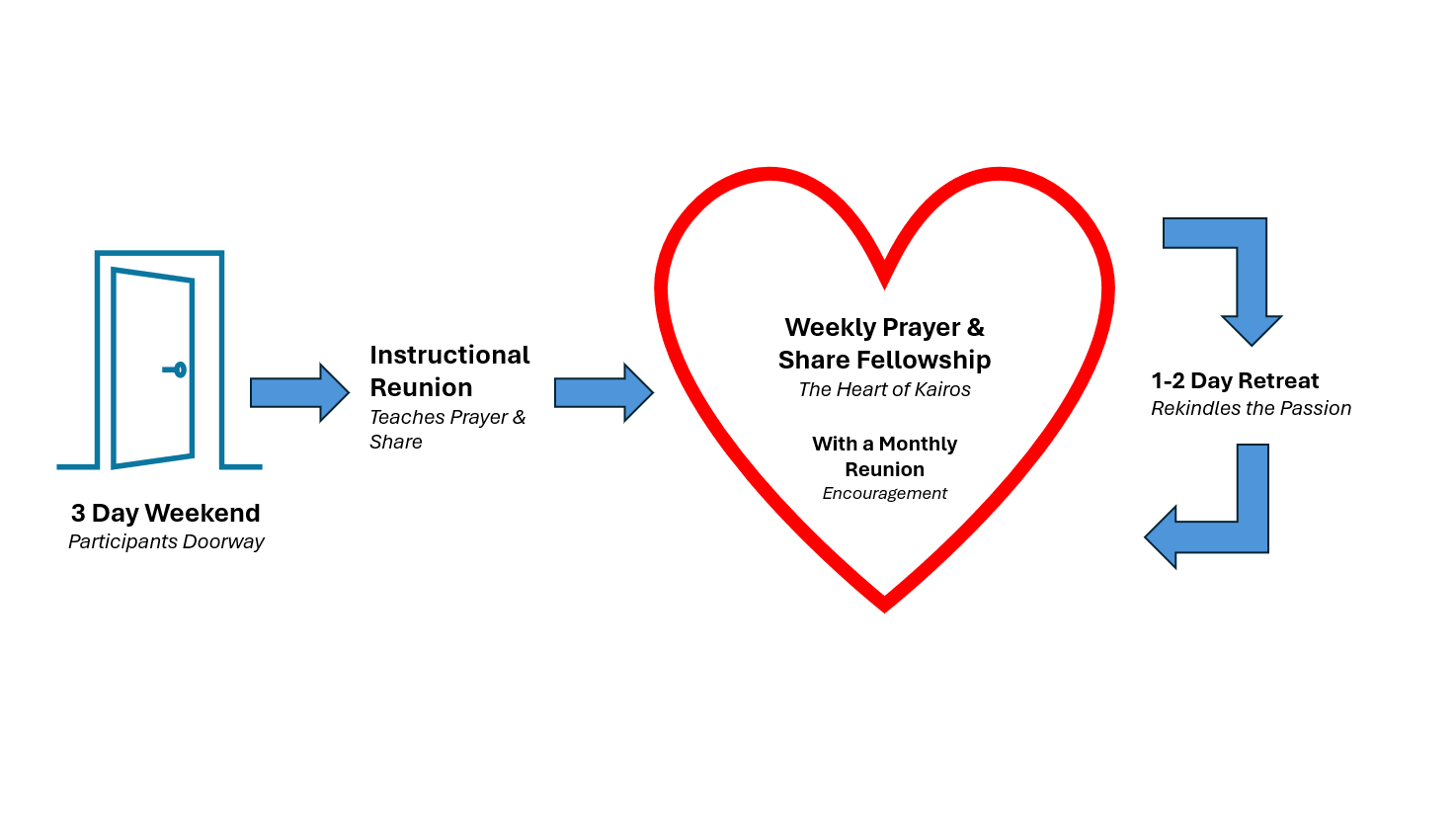
Kairos Weekend
The Kairos 3 1/2 Day Weekend is the doorway or on-ramp to the in-prison community of believers, called the Kairos Community. During each of two Kairos weekends per year, 42 inmates, which we call "Brothers-in-White", come together with about 30 Kairos Inside and 20 Kairos Supporting Volunteers, and the existing Kairos in-prison ministry leaders; to grow the Kairos Community through teaching, worship, prayer, and an abundance of love. The Weekend discussions include:
Encountering Kairos -- To reduce anxiety and begin building comfort levels
Encountering Self -- To understand yourself and your standing with God
Encountering Christ -- To meet Jesus and the Body of Christ and find forgiveness in Jesus Christ
Encountering Others -- To begin the process of growing in faith and community with others
For many Brothers-in-White, the Kairos Weekend creates the desire to become Christians or fuels the fire to continue their spiritual growth.
Kairos Instructional Reunion
The weekend is followed by an Instructional Reunion led by the Kairos Inside Volunteers. At the Instructional Reunion the newer members of the Kairos Community coming out of the 3 1/2 day weekend are given guidance, by example, in how to pray and share with fellow believers.
Kairos Prayer & Share
Called the heart of Kairos, this is a weekly gathering of Kairos graduates where they share their personal concerns and have a chance to support each other.
Monthly Reunions
This is a time of worship and teaching whose purpose is to encourage and expand the impact of the Kairos community. During this time, inmates who have not graduated from a Kairos weekend may attend.
Participant Experience Overview
Weekend and Instructional Experience and Talk and Meditations Summary 11 pages August 12 2026
Contents
Weekend and Instructional Summary
Introduction
Today I would like to summarize the talks and chapel meditations that are interwoven and together with the welcoming music, poster parties, forgiveness cookies and the cross ceremony make up a Kairos Weekend.
But let’s first look at the backstory. A Kairos weekend begins maybe 1-2 years before the weekend when the leadership team for that weekend is prayerfully selected by the Advisory Council of that specific prison unit. The future weekend leaders then go through Advanced Kairos Training and then progress from being an Inside Coordinator, Head Servant, Chapel Coordinator or Agape Coordinator; then an Observing Leader, and then finally the Weekend Leader. Some may be a Support Team Leader as well.
These are the specific prerequisites for a person to be a Weekend Leader.
Same gender as inmates served
Lay-person
Worked a minimum of four (4) Weekends before being Weekend Leader
Must have served three (3) Weekends before serving as Observing Leader
Must have been seated at a family table for an entire 3 ½ day Weekend
Must have served in at least one of the following positions: Inside Coordinator, Head Servant, Chapel Coordinator or Agape Coordinator.
Must have presented at least two (2) talks and/or Lay Forgiveness meditation 4-part series
Must have attended Advanced Kairos Training 12-24 months before leading the Weekend, and before serving as the Observing Leader
Willing to follow the Program Manual and the policies and procedures of Kairos and use EZRA
Recruitment
For each Weekend Leader, the Advisory Council Chair, the Observing Leader, the Support Team Leader, and the immediately prior Weekend Leader (now called the Advising Leader) begin a process of identifying and contacting potential volunteers for the weekend. It is the responsibility of the entire Advisory Council to recruit volunteers but practically that responsibility falls on a core group of volunteers.
In terms of numbers, each weekend has both inside and outside team volunteers, with runners connecting the two throughout the weekend. At a minimum, a weekend needs 3 volunteers per table who sit with 6 inmates. Given a target number of 7 tables, that means we need 21 volunteers to sit at the tables to listen to and love on 42 inmates. Supporting these 21 volunteers and 42 inmates are the following positions on the inside team: the Inside Coordinator, the Chapel Coordinator, the Head Steward, the Institutional Coordinator, the Observing Leader, and the Weekend Leader, for a total of 27 inside volunteers. However, one of the goals of a weekend is to have a sufficient number of volunteers to greet each of the 42 inmates. That would bring the total to somewhere between 27 and 42. The idea is that the greeter not only greets the inmate on Day 1 but also maintains contact with the inmate throughout the weekend. Practically, some of the volunteers double up and are responsible for more than one inmate. So about 34 volunteers probably work.
KPMI has a detailed chart on the required number of volunteers.
Support Team
There are also the support team volunteers. This part of the team is essential for the success of the weekend because they supply the food and coordinate the logistics so that about 600 meals are served throughout the weekend. There is the Support Team Leader, an Inventory Lead, a Kitchen Lead, a Kitchen Coordinator and a Cookie Lead. The Support Team then has additional volunteers that bring the total up to a minimum of 12 and hopefully up to about 15 or more volunteers.
The Agape Coordinator works for weeks to ensure that the men in white each receive Placemats and Meal Tickets for each meal. In addition, the coordinate the delivery of the Prayer Chain and Posters from other Kairos communities. These are tangible expressions of God’s love for the men in white.
For a weekend we need about 27-42 inside volunteers and about 12-20 support team volunteers, plus 2-3 runners who go back and forth throughout the weekend to have an operationally efficient weekend.
Mix of Volunteers
At each table sits a Table Leader, a Clergy Member and an Assistant Table Leader. The Table Leader is a Kairos Veteran. The Clergy Member may be an ordained clergy, which is ideal, or a person who has the qualities of a clergy member but is not ordained. The Assistant Table Leader is there to participate and observe so that they may one day be a Table Leader.
To ensure the continued ability of Kairos to be sustainable, Kairos suggests that each weekend have a significant number of new volunteers. A targeted mix of 1/3 New Volunteers and 2/3rds veteran volunteers is ideal.
In addition to having a mix of Kairos veterans, new Kairos Volunteers, and Clergy, there are also additional suggestions that fill in the mosaic which becomes the weekend team.
Ex-offenders are invited to join Kairos Teams and have a transformative effect upon both the other volunteers and the 42 men who are selected for the Kairos weekend. When they sit at a table, greet an inmate, or give a talk or chapel meditation, they reach deeply into the hearts of the prison population.
Participants
A balanced ethnic volunteer and participant makeup is also essential for any weekend. When we select the 42 inmates, we seek a balance that reflects the prison population, and which also enables us to balance each table with blacks, whites, and Hispanics. The purpose of this is to break up gang influence at the tables.
Participants are also selected to include some who are already spiritually mature believers but who would like to become members of the Kairos community; some who are just coasting along; and some who are leaders but leading for the wrong spiritual team. A balance of participants is the goal.
Spiritual Formation
Each Kairos volunteer is asked to commit to a set of basic Christian beliefs. This provides a foundation of a common faith from which the team can act in unity for the benefit of the 42 weekend participants.
Stewards, Service
For each weekend, we also select about 15 stewards who ensure the smooth running of the weekend. These men represent those men within the prison who are eager to serve, or in some cases, are given the opportunity to serve for the first time. They receive the food sent in by the support team and distribute the food, serve the drinks, help set up and take down, and clean up after each meal.
Music
In addition to this, Stewards may also, in some units, provide the worship music throughout the weekend. There may be as many as 173 songs in a chord book provided to the music team, of which some 50 plus songs may be played throughout the weekend. The songs are selected to reinforce the spiritual flow of the weekend. In some cases, chord books and slide decks may be provided to the internal Kairos team. In other cases, the volunteers may provide all or part of the music team. A Kairos volunteer is assigned to provide leadership and oversight to the music team. The focus of the team is never to perform but to lead the 42 into transformative worship. Sometimes silly songs like “Pharoah, Pharoah” are good lighthearted medicine that helps break down walls.
Volunteer Training
"Training occurs over a five-day period, and each day of training mirrors the activities of the corresponding three and half days of the Kairos Weekend." Quote from DM
Prior to each weekend, the volunteers are asked to participate in 4 team meetings and a 5th meeting the morning before we go into prison. Each Team Meeting seeks spiritually and operationally to prepare the volunteers for the weekend. The goal is to have the volunteers’ hearts and minds prepared for the weekend so that their actions reflect the love of Jesus Christ, that is, the inspiration and leadership of the Holy Spirit of Christ within each person and the guidance of both the written word and the personal word of God to each participant. And that the team stays within the nine Kairos Riverbanks. The development of this is a deeply personal and spiritual work that occurs with each volunteer and reflects the outworking of the Spirit of God resident in them.
The fact is that the fruit must flow from the nourishment of the sap that comes from the root, Jesus Christ. Without each volunteer abiding in Christ, Christ will not abide in the weekend.
The Heart of Kairos
It must be noted here that the goal is not just a successful weekend – which would be defined as the hearts of men and women being transformed, and thus the prison unit itself being made new but that a vibrant and thriving Kairos community be established within the prison itself. While there are only two weekends per year, and perhaps two one or two-day intervening gatherings, there are also weekly Prayer and Share meetings. These usually occur for about two hours each Saturday and consist of brief announcements, worship music, a scripture reading, a devotional, some social coffee time and, critically, a time when the Kairos community can share their hearts and hurts and victories with other members of the community, with each other. Over time this results in a healthy and strong group of believers with the prison who then become evangelists reaching out to their fellow prison population. While each weekly prayer and share event, absent one, consists of only Kairos graduates, the Kairos community is asked to reach out to others within the prison to invite them and be their guests at one gathering each month. This is called a monthly “Reunion”. It may occur on a regular basis, like the fourth Saturday of each month.
Within each Kairos Community, is a team of three men who have been selected as community leaders. Each year a new leader cycles in and one who has served for 3 years cycles out, so that there is a constant stream of new leaders. The leader ballot may be proposed by the existing community leadership, the chaplain, the warden and even the Kairos volunteers. The qualified ones may be placed in a hat, so to speak, and the new person may be randomly selected out of the group of qualified candidates. There is a voting process that may underly the selection.
Volunteers Supporting the Heart of Kairos
Recognizing that Volunteers have busy lives and many feel stretched just doing a weekend or two each year, Volunteers are also asked to attend one Prayer and Share Saturday each month. For a prison, you might have a PNS coordinator who works with weekly PNS sub-coordinators to staff each of the weekly PNS events. We always want to have at least two people who commit to attend each PNS, ideally three. But for the Reunions, because we get to sit with the inmates, we would like to have one volunteer for every 7 inmates who attend the Reunions. So, if 70 attend, we need 10 volunteers. When a person commits to a Weekend they are also committing to attending the Reunions. Practically many do not attend all of them but attending some of the Reunions encourages the Men in White. At each PNS meeting, volunteers do not sit with the PNS groups but may sit with each other. The reason is we want the men in white to develop real relationships with their fellow prisoners and when we sit with them, it disrupts that dynamic. This means the PNS meetings are about volunteer servanthood.
Participant Selection
For each weekend, inmates put in requests called “I-60’s” to attend the Weekend. The chaplain and warden select the attendees. They may choose to consult the Kairos Community leadership and the Kairos Institutional Coordinator in the selection process. The former may have specific inmates in mind while the latter may just give general guidelines – a good racial mix, a good number of “hard heads” who are leaders who can greatly influence the spiritual status of the prison, now, for the good.
The Weekend Experience
This section will focus on the view from the eyes and heart of one man of the 42 inmates selected for the prison.
Keep in mind that just as in the free world, the makeup of the prison consists of Christians, unbelievers, believers in other faiths, people who have been loved, and many who have never been loved, or worse, loved in the wrong way. Each person experiencing the weekend may be a prodigal or a pagan – and either may have purposely done what got them there or may have just stumbled into prison by accident or by a single action. While most are guilty of something, a few may be innocent. We will seldom know. But we do know this: “All volunteers and participants have sinned and fall short or the glory of God.” And we each need to experience the love of Jesus Christ whose life, burial, and resurrection power make us right with His Father, the faithful covenant keeping God of Abraham.
The participant’s weekend starts on late Thursday afternoon when we greet them and finishes on Sunday afternoon when they attend the Closing Ceremony.
Day 1 - Thursday
While the Volunteers begin the weekend with a setup on Wednesday, the participants congregate in the chapel on Thursday and are arranged alphabetically so that they may then enter the gym in a known order and greeted by the Greeter to whom they have been assigned. [If a Greeter has been assigned more than one Participant, then the Participants are staged next to each other.] Meanwhile, all the inside volunteers line up in a gauntlet – much like at a football team – and a volunteer announces their entrance into the room by stating their name. Their new fans cheer as they enter. Their Greeter introduces himself and escorts their participant to a table. The primary goal here is for the Participant to feel safe. Each participant receives a Nametag, is escorted to a table, and begins a dialogue with their Greeter.
Throughout the Weekend, the participants will hear 10 Talks and Chapel Meditations. On Thursday the participants will hear these:
Chapel 1. Know Yourself: A reflection on how Jesus “sees” and knows us personally (using Nathanael in John 1:43–51). The main invitation is to stop hiding behind masks, to be honest about what’s really inside yourself, and to let Christ meet you in truth—because real spiritual growth starts with self-knowledge and being known by God.
Chapel 2. I Chose You: A personal-witness style meditation built around Jesus’ initiative in our lives: He chooses us first, calls us into relationship, and invites a response. The emphasis is on moving from “religion” to friendship with Christ—accepting being chosen and choosing Him back in trust and commitment.
Friday
Chapel 3. Three Encounters with Christ: Three gospel encounters are contrasted to show different responses to Jesus: the rich young man (attachment/hesitation), Judas (betrayal), and Peter (failure followed by repentance and restoration). The thread is that Christ meets each person truthfully, and even when we fall, the call is to turn back, receive mercy, and follow again.
Talk 1. Choices: A lay talk (20 min) aimed at moving participants from “victim of circumstance” thinking to personal responsibility and agency—showing how the course of life can change through choices made from now on. Key themes are how choices form patterns, choices in prison settings and the shift from reacting to responding (e.g., “EVENT + REACTION…” vs. “EVENT + RESPONSE…”).
Talk 2. You are not Alone: A clergy talk (20 min) centered on the truth that God made us for community, and that we need both God’s presence and other people’s support. A major portion is devoted to explaining and presenting General Agape (posters, prayer chains, placemats), emphasizing that people worldwide are praying for the participants and thus they are part of a larger community.
Talk 3. Friendship with God: This talk defines what a true friend is (someone who wants the best for you, doesn’t abandon you, etc.) and then builds the message: God wants to be our friend, not an enemy waiting to punish. It explains Jesus’ role in completing God’s offer of friendship and introduces the “Friendship with God” symbol (wooden circle) that becomes the foundation for the later 3-legged stool talks. God’s role is that He fulfilled His covenantal promises to Israel when Jesus came and announced, “Repent for the Kingdom of God is at hand” and then died, was buried, and was resurrected on the first day.
Chapel Homily I will Never Forget You: A homily anchored in Isaiah 49:15–16: even if human love fails, God does not forget—His love is steadfast and personal. The message comforts people who feel abandoned or erased, stressing God’s enduring remembrance and care.
Chapel: Acceptance of Self: The first talk in the forgiveness series focuses on forgiving and accepting yourself: naming shame, guilt, anger, pride, and denial, then choosing honesty and self-responsibility. It frames self-acceptance as aligning with God’s view of you (beloved, redeemable) so you can move forward in freedom.
Talk 4: The Church: A lay talk (20 min) designed to present the Church positively—especially for participants who may distrust or dislike it—and to connect the “You Are Not Alone” message to what the Church is. It explores why people withdraw and build walls, then defines the Church as the Body of Christ / God’s people (not buildings or organizations) and drives home: “We are the Church!”
Talk 5: Opening the Door: This talk addresses why people hesitate to begin with God (hurt by church people, rejection, feeling “not good enough,” or viewing faith as rules instead of relationship). It says opening the door is a simple but courageous act of surrender (letting go of ego/control) and introduces Spirituality as the first leg of the “Friendship with God” 3-legged stool, including practical spiritual exercises (prayer, Bible reflection, meditation, self-exam, etc.).
Chapel Accepting God’s Forgiveness: Centers on God’s desire and power to forgive, pushing back against the belief “my sin is too big.” It uses scripture and the “treasure/pearl” idea to emphasize our worth to God, and encourages confession, humility, and receiving forgiveness as grace—not something we earn.
Saturday
Chapel: Who is Jesus Christ: A Christ-centered teaching that explains Jesus as the Messiah/Christ (anointed one) and more than a moral teacher—inviting participants to respond to who He truly is. The goal is not just information, but a call to trust, surrender, and relationship with Christ.
Chapel: Forgiveness of Others: Builds the biblical necessity of forgiving others (Lord’s Prayer; “seventy times seven”; parable of the unforgiving servant). It defines forgiveness as an act/decision (not merely feelings) and introduces the practical step of writing names and asking the Holy Spirit to reveal who you’re holding in unforgiveness.
Talk 6: Discovery: A lay talk (20 min) teaching that the Christian life is an ongoing journey of discovery—entered through study, prayer, listening, and sharing—and it visually adds STUDY as the 2nd leg of the stool (still unstable without the 3rd leg). It emphasizes that without continued learning, we “shrivel up” spiritually, and it frames the Bible as “a book of directions,” best pursued individually and in groups.
Talk 7: Christian Action: A lay talk (20 min max) that completes the stool by adding the 3rd leg: ACTION, arguing that without action “Christian” becomes only a label. The core is that Christian action is summed up in LOVE (agape)—wanting the best for another person. It provides concrete guidance: “Ten Commandments of Agape Love,” and the Kairos method: “Make a friend, be a friend, bring a friend to Christ.”
The stool now consists of Spirituality, Study, and Action.
Chapel: Then Wall: A metaphor story by Gloria Jay Evans about the “wall” we build from hurts, fear, and resentment to keep others out—only to become trapped behind it ourselves. The message urges letting God help dismantle that wall and choosing connection, humility, and love over self-protection.
Chapel: Forgiveness of Others Part 2: Moves forgiveness toward mature love: God loves our enemy too, and we grow by learning to say “yes” to God’s call to love, forgive, and become vulnerable. It includes a guided prayer offering up “my names,” asking God to remove resentment and heal relationships.
Chapel: Forgiveness Windup Homily: A brief, forceful assurance that no sin is beyond God’s forgiveness. The message is tied to grace and cleansing (Isaiah/1 John language). Its aim is to give hope and courage right before the symbolic forgiveness ritual.
Chapel: Forgiveness Windup: Step-by-step instructions for the forgiveness ceremony: participants come forward (by family or individually) to burn lists or dissolve them in water, with prayer at the bowl/bucket; a cleansing-water action and closing communal song. It also stresses maintaining reverence because this is a heavy, “life-or-death” spiritual moment for participants.
The four forgiveness meditations are a cornerstone of the weekend.
Sunday
Chapel: Prayer to Heal Past Memories: A guided prayer/meditation acknowledging that forgiveness doesn’t automatically remove the pain of memories. It asks Jesus to walk back through one’s life, heal the wound and the “poison” of past hurts, and patiently continue the healing process over time.
The Rooster Story: A short story (banty rooster) used as a spiritual illustration: Once God forgives you, do not go back and relive your failures.
Talk 8: Obstacles to Accepting God’s Grace: A lay talk (20 min) meant to be realistic about prison life and identify “roadblocks” that hinder living in grace—especially rejecting the “the devil made me do it” excuse and calling for personal responsibility in decisions. It defines grace as a free, undeserved relationship with a forgiving Father, then names obstacles as People, Places, and Things. These may include hypocrisy in others, tempting locations, and old habits like gossip, drugs/alcohol, and pornography, etc..
Talk 9: Walking in God’s Grace: This talk is about maintaining a post-weekend life “favored by God”, using the 3-legged stool (Spirituality, Study, Action) as an ongoing self-check. The Talk suggests practical tools for day-to-day life such as: prayer/devotion, community, Bible reading, moral inventory, and recognizing our own opportunities to “react or respond”. It warns against “cheap grace” thinking and strongly reassures that God will not let go—illustrated with the alligator story whose point is “God will not let go!!”
Talk 10: Hang in There: The Weekend Leader’s closing talk emphasizes that the Kairos Weekend is only the beginning of a lifelong journey with God and challenges participants to carry the love, joy, and community they have experienced back into the compound. It stresses that there are “no Lone Rangers in Christianity”: believers need one another, should support the chaplain and the growing Kairos community, and must avoid both spiritual pride and the discouragement of believing they are powerless.
It then introduces the practical means for “hanging in there” including the Instructional Reunion, weekly Prayer-and-Share groups, Monthly Reunions, and later Residents’ Retreats—so that participants can continue praying for one another, sharing spiritual needs, building Christian fellowship, and spreading Christ’s love throughout the institution. The talk concludes with a practical demonstration of Prayer-and-Share grouping and mutual prayer, preparing participants to sustain the Christian community after the Weekend ends.
Instructional Reunion
The Instructional Reunion is designed to move Kairos graduates from the powerful experience of the Weekend into an ongoing Christian community within the institution. The Weekend is only the beginning. Prayer and Share fellowship helps residents continue growing in Christ through mutual support, accountability, prayer, listening, and encouragement. The goal is not dependence on outside volunteers, but a strong Christian community among the residents themselves.
The Instructional Reunion should be held as soon as possible after the Weekend, preferably the following weekend, while the experience is still fresh. The teaching is experiential: participants do not simply hear about Prayer and Share; they practice it. Where formal weekly grouping is permitted, that is the preferred model. Where it is not permitted, residents are encouraged to practice the same principles through informal Christian fellowship wherever opportunities exist.
The central message is that Christians are not meant to live alone. “We are the Church.” Christian life is lived in koinonia—fellowship with Christ and with one another. The trust and relationships formed during the Kairos Weekend can continue through Prayer and Share. Confidentiality is essential: what is shared in the group stays in the group.
The Six Instructional Talks
Talk 1 – Spiritual Listening: Teaches participants how to truly listen to another person with the heart—without judging, preaching, interrupting, analyzing, or immediately giving advice. Spiritual listening affirms the worth of the speaker and is presented as a practical way of showing Christlike love. Participants practice the skill in small groups.
Talk 2 – A Moment of Christ’s Presence: Helps participants recognize moments when Christ has been especially present in their lives. Using Paul’s encounter with Christ as an example, the talk emphasizes that a genuine encounter with Christ produces spiritual growth and changed life. Participants then share a recent “close moment” with Christ.
Talk 3 – What Have You Learned?: Focuses on spiritual discovery through study and Christian growth. Participants are encouraged to identify something God has recently taught them or a new insight that has brought greater understanding to their lives and then share it with others.
Talk 4 – Helped Recognize God’s Love: Challenges participants to identify a specific time when something they said or did something that helped another person recognize God’s love. The emphasis is on Christian servanthood and using our God-given gifts to reveal His love to others.
Talk 5 – A Time When It Has Been Difficult to Show Christ’s Love: Recognizes that Christian love is often hardest with difficult people. Participants reflect on situations where loving another person has been challenging and learn that agape love is an intentional commitment made possible by God’s grace. Prayer and Share provides encouragement and accountability to keep trying.
Talk 6 – Joys and Concerns Which We Can Pray About Together: Encourages participants to honestly share their joys, struggles, failures, temptations, and needs so the group can support and pray for one another. The purpose is to deepen Christian fellowship and help members become Christ’s presence to each other through prayer, love, and encouragement.
The closing challenge recognizes that prison life often teaches distrust and self-protection. Opening oneself to others can feel risky, especially for people who have previously been hurt. Yet withdrawing from Christian fellowship can also separate a person from one of the primary ways Christ ministers through His body. Participants are therefore encouraged—but never pressured—to take the risk of Christian community, meet regularly when possible, and use Prayer and Share as a disciplined means of continuing what God began during the Weekend.
The Instructional Reunion ends with the reminder that Kairos is not simply a Weekend; it is a continuing Christian community. Through listening, sharing, prayer, confidentiality, love, and mutual encouragement, residents learn to become Christ’s presence to one another and to carry that love throughout the institution.
Instructional Reunion Summary
A. PURPOSE
1. Importance of Prayer and Share Fellowship
The purpose of Kairos is to build strong Christian community inside the prison through Prayer and Share fellowships. The Instructional Reunion is essential because the Weekend experience alone is not enough to sustain that community. Participants return to an environment filled with pressure, isolation, and distrust, so they need ongoing fellowship with other residents, not dependence on team members. The team’s role is to help residents connect with one another in authentic Christian community and accountability.
3. Instructional Reunion - Teaching Prayer and Share
Held as soon as possible after the Kairos Weekend, the Instructional Reunion teaches recent graduates how to become active in ongoing, small Prayer and Share fellowship. Its goal is to move them from being ministered to during the Weekend into practicing mutual support, vulnerability, and Christian fellowship with one another in the institution.
4. Timing
The reunion should happen immediately, preferably the following weekend, so the ministry can build on the spiritual momentum of the Kairos Weekend and encourage stronger commitment to Prayer and Share.
5. Responsibility
The leader of the just-completed Kairos Weekend is responsible for the Instructional Reunion. A coordinator may handle logistics, and there should be one family/group facilitator for each six participants.
B. THE INSTRUCTIONAL REUNION METHOD
1. The Teaching Experience
The Instructional Reunion is a teaching tool that uses experiential teaching. Participants do not just hear about Prayer and Share; they practice its methods during the reunion itself.
a. Formal Grouping
When the institution allows formal weekly grouping, that is the preferred model. It places the ongoing fellowship under chaplain oversight and usually follows the family structure formed during the Kairos Weekend.
b. Informal Fellowship
When formal weekly grouping is not allowed, the focus shifts to informal Christian fellowship among residents. This should never be presented as lesser or “diminished.” The emphasis remains on ongoing accountability, discipling, and Christian support in whatever settings are available.
2. Selecting Prayer and Share Families
The Kairos manual strongly recommends beginning with the same families formed during the Kairos Weekend. Those families already have trust, shared experience, and balance, which makes participants more likely to stay involved. Even in institutions where ongoing fellowship is more informal, the familiar family structure is still the best setting for the Instructional Reunion itself.
3. Schedule
The day follows a structured schedule: setup, organization into family groups, leader’s introduction, the first talk on spiritual listening, five short talks tied to Prayer and Share themes, lunch, a second leader talk, formation of Prayer and Share groups, and closing.
4. Talks
There are six talks total. The first talk introduces spiritual listening and includes a handout and practice session. The other five brief talks each focus on one part of the Prayer and Share process. Only one team member should be with each family group, and the goal is not to build strong team-member bonds but to help residents build their own Christian fellowship. Each talk begins with the Kairos Community Prayer, and the group discusses the assigned question from a personal, accountable point of view.
C. LEADER SPEECHES
1. LEADER’S OPENING TALK
LOVING AND BEING LOVED IN CHRIST
The opening talk teaches that Christians are not isolated individuals; they are the body of Christ. “We are the church.” Christian life is meant to be lived in community, or koinonia, not as “Jesus and me” alone. The Weekend introduced participants to that reality, and Prayer and Share is the way it continues.
The talk explains that continuing fellowship matters whether the institution allows formal weekly meetings or only informal fellowship. The purpose of the Instructional Reunion is to explain the Prayer and Share concept, encourage participation, and stress that confidentiality is essential. What is shared in grouping stays in the group. Participants will remain in the same small groups through the day and hear six short talks with discussion after each.
A. If the institution allows formal, weekly grouping, AND you will start Prayer and Share groups as the families from the Kairos Weekend, use the following…
The leader emphasizes that the miracles of the Kairos Weekend can continue through weekly Prayer and Share with the same table family. The Prayer and Share card gives a practical, disciplined path for spiritual growth, just as exercise builds physical strength. Weekly grouping helps residents hold on to what they discovered during the Weekend.
B. If the institution does NOT allow formal weekly grouping, use the following…
The leader explains that even without formal weekly meetings, ongoing Christian fellowship is still vital. Participants should look for opportunities to practice Prayer and Share informally with other Kairos brothers and sisters in the yard or housing unit. The benefits of this fellowship outweigh the risks, and confidentiality remains essential. The day’s instruction is meant to help participants understand the concept and encourage them toward this continuing fellowship.
LEADER’S CLOSING TALK
The leader reads part of a resident’s letter explaining why he or she stopped grouping: prison life has trained many people to distrust others, fear vulnerability, and avoid close Christian fellowship. The letter says some residents have been hurt even by other Christians, so the risk of opening up feels too high. The leader’s point is that this fear is understandable, but tragic, because the resident is cutting himself or herself off from the very Christian community through which Christ often becomes present. The talk ends by noting that the next section depends on the institution’s grouping rules.
A. If the institution allows formal, weekly grouping, AND you will start Prayer and Share groups as the families from the Kairos Weekend, use the following…
The leader says the miracles of the Kairos Weekend can continue through regular Prayer and Share with the same Kairos family. Participants are encouraged to meet weekly, use the Prayer and Share cards step by step, and understand that spiritual growth requires discipline just as physical growth does. The small group process is presented as the practical way to hold on to what God began during the Weekend.
B. FORMATION OF GROUPS - INTRODUCTION
The leader reminds participants that their Kairos family placement was prayerful, intentional, and meant to provide a trustworthy starting place for Prayer and Share. They are encouraged to begin as the family where love and trust have already started to grow, even if later they may choose differently. The page also notes practical instructions for gathering names, coordinating callouts, if needed, and working within institutional security requirements.
B. If the institution allows formal, weekly grouping, AND you will start Prayer and Share groups by allowing the Participants to select a group, use the following…
This option still stresses that the Weekend’s blessings can continue through Prayer and Share, but it allows participants to form or choose groups instead of staying in their original Kairos families. The leader explains that weekly Christian fellowship is good, but disciplined Prayer and Share is better than casual Bible talk because it gives a real pattern for growth, accountability, and continued strength in Christ. Grace and love are still necessary, so grouping should not become rigid or harsh.
GRADUATES SELECT THEIR GROUPS
At this point the leader steps aside and lets participants begin moving into groups. Team facilitators are told to be especially attentive to those who hesitate or hang back, since those may be the people who most need gentle encouragement. No one is to be pressured. Fear of rejection should be recognized and ministered to, and facilitators may walk up with hesitant residents if needed. The emphasis is patience, prayer, sensitivity, and avoiding force.
C. If the institution does NOT allow weekly grouping, use the following…
If formal weekly grouping is not allowed, the leader still urges participants to continue Prayer and Share informally. The same Prayer and Share cards can guide one-on-one or small informal fellowship during the week. The message is that spiritual life still needs discipline, balance, and mutual strengthening, even outside a formal structure. Participants are urged to share with one another in the same spirit they experienced at the reunion so they can remain healthy members of Christ’s body.
Final Reminder About Confidentiality
The leader gives a final, strong reminder that what is shared in grouping must remain confidential. Trust is essential to Prayer and Share, and misuse of someone’s personal story can destroy that trust. The manual also warns that information, photos, recordings, or identifying details must not be used publicly without written permission. Any exceptions are guided by PREA and other legal reporting requirements.
Closing of the Instructional Reunion
The day ends by forming a circle, symbolizing God’s unbroken love and the group’s commitment to walk together in that love. The gathering closes with “Surely the Presence” and the Lord’s Prayer. After goodbyes, residents leave first, and then the team departs after a short time of prayer and thanksgiving.
D. TALK OUTLINES
The manual says there are six talks. The first is longer because it teaches and practices spiritual listening. The remaining five are brief talks built around the Prayer and Share card topics.
TALK #1
SPIRITUAL LISTENING
HANDOUTS:
A handout should be distributed before the talk, and family group facilitators use it during the practice session.
PURPOSE:
To teach basic listening skills as a way of ministering to one another. Listening is presented as one of the simplest and most powerful gifts we can offer, especially in a prison setting, because it affirms a person’s worth and models Christlike care.
PRAYER:
Kairos Community Prayer.
I. HOW MANY OF US WOULD RATHER TALK THAN LISTEN?
Most people naturally prefer speaking to listening. We often wait for our chance to jump in rather than truly hear another person. But real listening opens relationships, deepens discipleship, helps us care for others, and reduces loneliness and exclusion.
II. SPIRITUAL LISTENING
Spiritual listening is different from ordinary listening. It means listening with the heart, putting the other person before our own need to be heard, and allowing the relationship to change. Its keys are surrender, prayer, and asking God to give agape love so that we understand another person’s pain and respond rightly.
III. WHAT HAPPENS WHEN WE DO SPIRITUAL LISTENING?
For the speaker, self-worth grows, thoughts become clearer, feelings come out instead of staying bottled up, and the speaker feels accepted. For the listener, it becomes a privilege and even a holy gift to receive another person’s inner life. The talk teaches that knowing a person without judging is a form of love, and that attentive listening builds deep human and spiritual bonding.
IV. HOW DOES ONE DO SPIRITUAL LISTENING?
It begins with a conscious decision to listen. At first it may feel awkward and demanding. The listener suspends judgment, stays open to another’s pain, uses attentive body language, maintains eye contact, follows both content and feelings, and offers simple affirming responses rather than taking over the conversation.
V. PITFALLS TO AVOID
The talk warns against “me-too-ism,” moralizing, preaching, judgment, curiosity-driven questioning, advice-giving, cheap consolation, arguing, analyzing, and ignoring heavy emotion. These all interfere with true listening.
VI. WHAT YOU GIVE AS A SPIRITUAL LISTENER IS AFFIRMATION OF SPEAKER’S WORTH.
Good listening is described as a gift both to the speaker and to the listener. It teaches the listener to see beyond bad behavior to the precious person underneath. The talk says Jesus is our model here: even difficult people carry great value before God, and love can help uncover and free that hidden child of worth.
VII. ASK THE FAMILIES TO PRACTICE SPIRITUAL LISTENING
Families are instructed to practice the skill, not just hear about it.
SMALL GROUP PRACTICE GUIDE
Families divide into groups of three with a speaker, listener, and observer. In three short cycles, each person rotates roles. Suggested questions include: “How do I handle rejection?”, “What kind of experience causes me to feel good about myself?”, and “What is my greatest fear?” Observers report briefly on the listening, and the facilitator asks how the group felt during the practice.
Spiritual Listening Handout
The handout condenses the main teaching: good things happen when we listen, spiritual listening differs from ordinary listening, and listening well requires deliberate, disciplined, nonjudgmental attention. It ends by stressing that good listening is a gift and that Jesus is the model.
TALK #2
A MOMENT OF CHRIST’S PRESENCE
The main emphasis is that a real encounter with Christ is identified not mainly by happiness or emotion, but by spiritual growth. The scriptural example is Paul’s encounter with Jesus on the road to Damascus, showing confrontation, grace, healing, baptism, and changed life. The speaker is then asked to share a vulnerable personal witness about a close moment with Christ during the past week, and the leader invites discussion in pairs.
Response by the Leader
Participants discuss the talk briefly, then share their own “close moments” with each other.
TALK #3
WHAT HAVE YOU LEARNED?
This talk focuses on new insight or revelation gained through study and Christian growth. The example in scripture includes Jesus’ teaching on loving enemies and references to Paul and Hebrews, showing that discipleship often involves a deeper understanding than we first had. The speaker is asked to share a personal witness about something learned during the week that brought new light to life, and the leader then directs pairs to share new revelations with one another.
Response by the Leader
Participants spend time in discussion and then share with a partner a new revelation they have gained in their study.
TALK #4
HELPED RECOGNIZE GOD’S LOVE
This talk matches the Prayer and Share card question about a time when, through some word or action, one helped another person recognize God’s love. It is designed to help participants reflect on concrete acts of love that reveal God’s care to others. A key point is our wholeness is reflected in our servanthood, as we share our God-given gifts with those around us.
TALK #5
A TIME WHEN IT HAS BEEN DIFFICULT TO SHOW CHRIST’S LOVE
This talk says Christian love is intentional and often hardest when directed toward difficult people. Real love is an act of commitment made possible by God’s grace. The Kairos pattern is “make a friend, be a friend, and introduce that friend to Christ.” Prayer and Share supports this action, offering prayer, affirmation, and accountability without condemnation. Even when our plans seem to fail, obedience matters more than visible success, and the only real failure is refusing to try.
TALK #6
JOYS AND CONCERNS WHICH WE CAN PRAY ABOUT TOGETHER
The purpose of this final talk is to open participants to the nurture and support of the group so they can better understand one another and be Christ to one another. The talk connects this practice to Jesus’ command to love one another and explains that Christian love desires the spiritual good of others. Participants are encouraged to share discomforts, failures, and needs honestly within the Prayer and Share setting, trusting that the response will be loving and strengthening. The scriptural example is the church at Antioch praying and sending out Barnabas and Saul. The speaker also names common obstacles people face, such as negativity, criticism, temptation, and being too hard on themselves.
Response of the Leader
The leader invites discussion, then has groups of four share their joys or needs and pray together for one another.
Detailed Weekend Talks Flow
Weekend Talks, Discussions